What Counts as Income for WA Child Support (2026 Guide)
Author
WSCSS Editorial Team
Reading Time
9 min
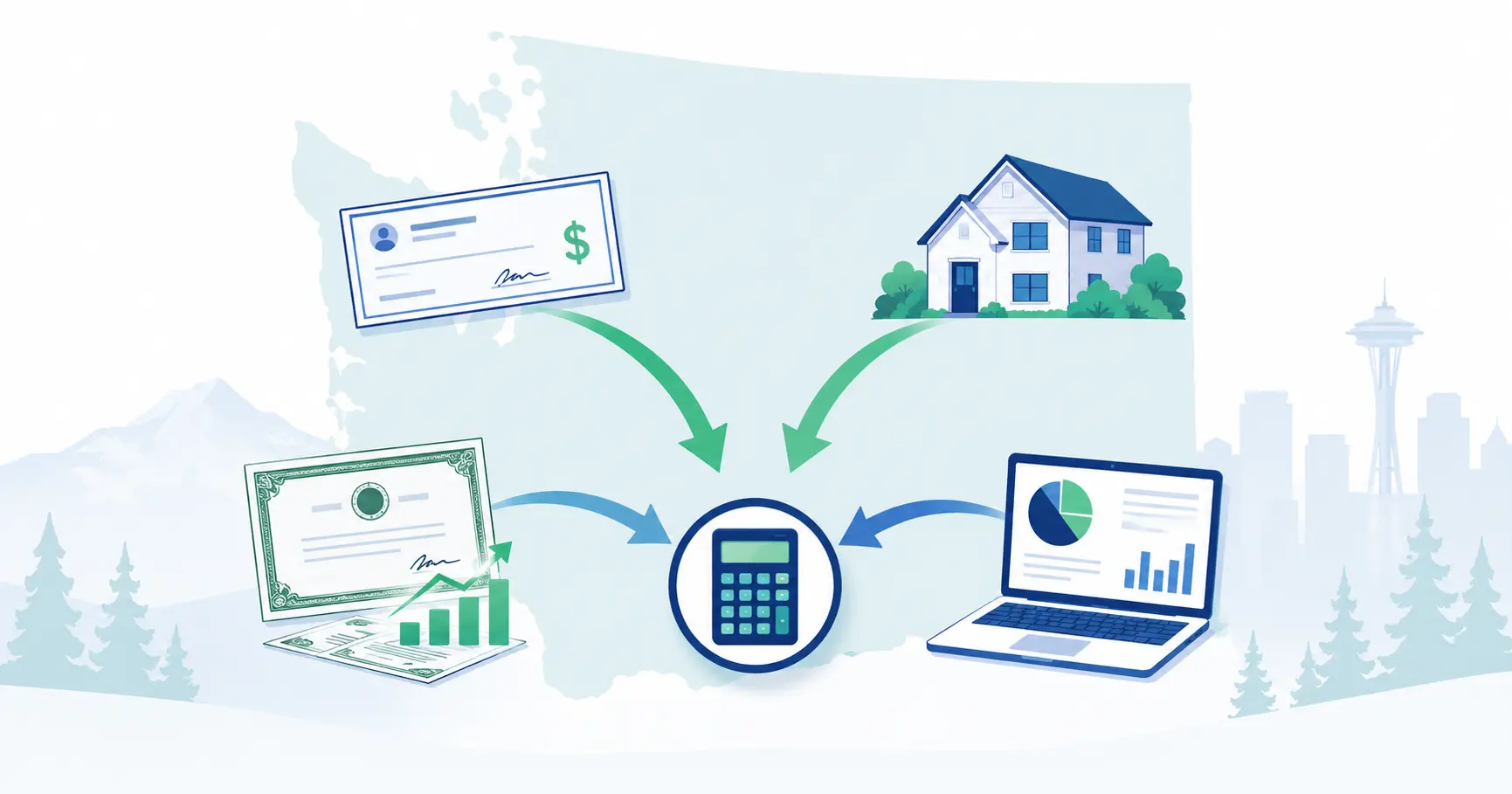
- Washington uses gross monthly income as the starting point, defined broadly under RCW 26.19.071
- Overtime, bonuses, and RSUs are all included and averaged over 12 months
- Self-employment income = gross revenue minus legitimate business expenses only
- New spouse's income is generally not included in the core calculation
- Courts can impute income if a parent appears voluntarily underemployed
Disclaimer: This guide explains Washington State's 2026 income definition for child support purposes. It is not legal advice. Consult a licensed WA family law attorney for advice specific to your case.
One of the most contested aspects of any child support case in Washington is what actually counts as income. The definition under RCW 26.19.071 is deliberately broad. The legislature did not want parents to be able to structure their finances to avoid supporting their children. Understanding exactly what is included, what is excluded, and what the court does when it suspects income is being hidden is essential knowledge for any parent going through this process.
| Category | Treatment |
|---|---|
| Wages and salary | Included, gross amount |
| Bonuses and overtime | Included, averaged over 12 months |
| TANF and SSI | Excluded |
| New spouse's income | Generally excluded from core calculation |
What Washington Includes in Gross Income
Washington's definition of gross income for child support purposes is expansive. Under RCW 26.19.071, it includes virtually everything a parent receives:
- Wages, salaries, commissions, and tips, the full gross amount before any deductions
- Overtime pay. Averaged over 12 months rather than based on a single high-earning period
- Annual bonuses, averaged monthly over the prior 12-month period regardless of whether they are recurring
- Self-employment income, gross revenue minus legitimate business expenses under the RCW 26.19 standard, not the IRS standard
- Rental income. Net of maintenance and mortgage costs directly associated with the property
- Unemployment compensation. Counts as gross income and can be garnished by DSHS
- Disability and workers' compensation benefits
- Social Security benefits — including disability payments received on behalf of the children, which are credited against the support obligation
- Pension and retirement income, distributions received during the calculation period
- Trust fund distributions, amounts actually distributed, not just trust value
- Restricted Stock Units (RSUs). Counted as income in the year they vest, reported on W-2
- Investment income, dividends, interest, and capital gains reported on tax returns
What Washington Excludes from Gross Income
The following are specifically excluded under RCW 26.19.071 and do not count toward gross income for child support purposes:
- Income of a new spouse or domestic partner. The other parent's new relationship does not affect your income calculation
- Public assistance benefits, TANF, food stamps, and similar means-tested programs
- Supplemental Security Income (SSI)
- Child support received for children from other relationships — not counted as your income
How Self-Employment Income Works
Self-employment income is the most frequently disputed category in Washington child support cases. Courts start with the business's gross revenue and then subtract what Washington considers legitimate business expenses — which is not the same as what the IRS allows on Schedule C.
Washington courts regularly add back deductions that reduce taxable income on paper but do not represent actual cash outflows, including:
- Depreciation on assets, not a real cash expense in the calculation period
- Home office deductions, unless the space is used exclusively for business
- Vehicle expenses that appear personal. Meals, entertainment, personal travel
- Excessive owner compensation structures used to minimize apparent income
If you are self-employed and facing a child support case, expect your Schedule C to be scrutinized carefully. Commissioners in counties like King County see this regularly and are experienced at identifying inflated business expense deductions.
| Business Deduction | WA Child Support Treatment |
|---|---|
| Depreciation | Often added back, no cash outflow |
| Legitimate operating costs | Deductible if documented |
| Personal expenses through business | Added back as income |
Imputed Income, When Courts Assign Income You Did Not Earn
If the court finds that a parent is voluntarily underemployed, meaning they have chosen to work less than they are capable of, it can assign or "impute" income at the level the parent could reasonably earn. This is one of the most powerful tools courts have against parents who try to reduce their apparent income to lower their support obligation.
Courts consider factors including the parent's work history, education, professional licenses, and the local job market when determining what income to impute. At a minimum, courts typically impute income at Washington's current minimum wage for full-time work. If your documented history shows you were earning $5,000/month and you suddenly claim $800/month after a separation, expect significant scrutiny.
Legitimate reasons for reduced income (a documented medical condition, industry-wide layoffs, or an involuntary termination) are evaluated differently. The key is contemporaneous documentation proving the reduction was not voluntary.
How Courts Verify Income in Disputed Cases
When one parent disputes the other's income disclosure, courts have broad fact-finding authority. They can order production of bank statements, credit card records, business financials, brokerage accounts, real estate records, and any other financial documentation relevant to establishing actual income. Lifestyle evidence (vacations taken, vehicles driven, housing maintained) can also be introduced to challenge claimed income figures.
Does My New Partner's Income Affect My Child Support?
Generally no — a new spouse or domestic partner's income is not included in the core child support calculation in Washington State. However, if you have significantly reduced your own working hours because your new partner is supporting your household, the court may impute income to you at the level you would otherwise be earning. The indirect effect is real even if the direct inclusion is prohibited.
Related Articles
- WA Child Support Calculation: Full Step-by-Step Walkthrough
- 2026 WA State Guidelines: Complete Handbook
- How Washington Courts Decide Your Support Order
Bottom Line
Washington's income definition is deliberately broad and courts are experienced at identifying attempts to minimize apparent income. Accurate, complete disclosure is both legally required and practically the best strategy, undisclosed income discovered during a hearing damages credibility in ways that affect the entire proceeding. Enter your accurate income into our calculator to get your 2026 estimate, then review the full calculation with the Professional Worksheet.
Calculate Using Your Actual Income
For official state resources and documentation, please visit the Washington DSHS or the Washington Courts homepage.
Calculate Your Child Support Using 2026 Income Rules
Free · RCW 26.19.071 Income Definition · All 39 Washington Counties
Keep Reading
Related Washington Child Support Guides

Understanding the $2,394 Self-Support Reserve (SSR) in 2026

Washington State Child Support Calculation Guide for 2026

Washington State Joint Custody Child Support Explained (2026)
Frequently Asked Questions About Washington Child Support
Washington uses gross monthly income as defined under RCW 26.19.071, which includes wages, salary, overtime, bonuses, commissions, self-employment income, rental income, unemployment compensation, disability benefits, Social Security, pension distributions, RSUs, and investment income. The definition is deliberately broad to prevent parents from structuring their finances to reduce apparent income.
Generally no. A new spouse or domestic partner's income is not included in the core child support calculation in Washington State. However, if you have significantly reduced your own working hours because your new partner supports the household, the court may impute income to you at the level you would otherwise be earning.
Calculate Your Exact Child Support
Get an immediate estimate based on the 2026 Washington State Economic Tables. Our tool accounts for the expanded $50,000 threshold and the $2,394 Self-Support Reserve.
Calculate Your Child SupportWSCSS Editorial & Legal Team
Our calculations and guides are rigorously audited by family law advocates and technical developers to ensure compliance with RCW 26.19 and the latest 2026 economic table updates. We maintain a strict editorial protocol based on official AOC mandatory forms and WAC guidelines.
Transparency Disclosure: WSCSS is an independent resource center. We are not a government agency or a law firm. Our calculations are provided for educational and estimation purposes based on the latest 2026 guidelines.
All WSCSS insights are reviewed for compliance with RCW 26.19.065 and official Washington State guidelines. Our team cross-references all data with official AOC publications.